


 QwikLive Insights
Why Should Every Banking Channel Understand the Core?
Customer-facing experiences should evolve around customer needs—not around backend complexity. A reusable Core Aggregation Platform creates the separation needed to let both sides move independently.
Why should the same complexity be solved again for every new experience?
Organizations continue to introduce new channels and customer experiences. Yet every new experience often inherits the complexity of the systems behind it.
When channels are tightly connected to underlying banking systems, every change introduces dependencies, integration effort, and operational overhead.
The challenge is not connecting more. The challenge is scaling experiences without scaling integration complexity.
Make complexity invisible to the channel
What if every channel could communicate in one consistent way? What if the complexity behind it could remain invisible?
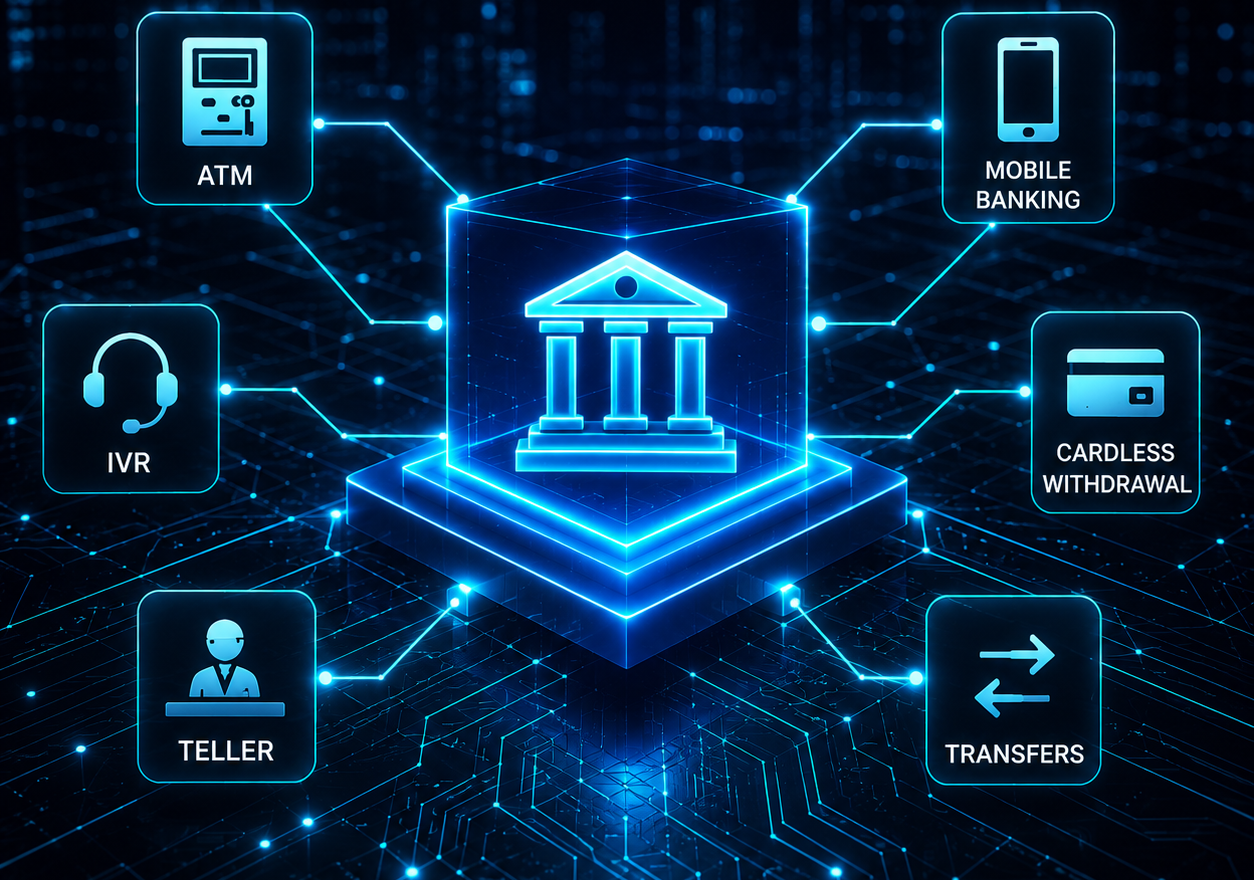
This is the principle behind Core Aggregation. A common aggregation layer separates customer-facing experiences from underlying banking systems. Channels interact with a consistent service model while the platform manages the complexity behind them.
One experience model. Multiple possibilities underneath.
Build for every experience that follows
A reusable platform should not depend on one client, one institution, one channel, or one underlying banking environment. Each layer should be able to evolve independently.
Channels evolve around customer needs, new service models, and changing expectations.
Connectivity and backend implementations can evolve without forcing every channel to change with them.
Separate experience from execution
The architecture creates a clear separation between who delivers the experience and how the underlying banking capability is accessed.
Change the starting question
Successful execution begins with a shift in mindset.
“How do we integrate this new channel?”
“How can this channel consume capabilities already available through the platform?”
The integration foundation becomes reusable, allowing teams to focus on the experience rather than rebuilding connectivity.
Integration should create flexibility, not dependency
Channels consume consistent services while QwikLive manages routing, orchestration, transformation, security, and operational visibility behind them.
Channels focus on experiences. QwikLive handles the complexity behind them.
Keep configuration and context consistent as the ecosystem grows
As connectivity expands, routing rules, service configurations, policies, and integration context need to remain consistent. Centralized management keeps this complexity within the platform rather than distributing it across every individual channel.
The result is an ecosystem that can scale without becoming increasingly difficult to operate.
Turn common banking capabilities into reusable assets
Common banking capabilities can be exposed through a consistent service model and reused across different experiences.
The strategic value is not simply providing another service. It is ensuring that capabilities do not need to be reinvented whenever a new experience is introduced.
What changes when experiences are separated from backend complexity?
Perhaps the biggest benefit is freedom: the freedom to evolve the experience without rebuilding the foundation beneath it.
Conclusion
For years, integration has focused on connecting one system to another. Core Aggregation introduces a different question: what if those systems no longer needed to understand each other?
Instead of connecting every channel directly to every underlying system, QwikLive creates a reusable abstraction layer between experience and execution.
The question is no longer “How do we connect the next channel?” It becomes “Why should the next channel need to care what sits behind it?”
